Affording to live comfortably right now is difficult, particularly for young people.
These four images prove that regardless of whether a young person is on universal credit, or working for minimum wage, paying for life’s essentials is extremely tough. In fact, those under 25 receive a lower Universal Credit entitlement despite facing comparable living expenses. This discrepancy is a frightening reality for so many young people, and places a constant strain upon them that when compounded with so many other pressures, build up over time and can result in homelessness.
[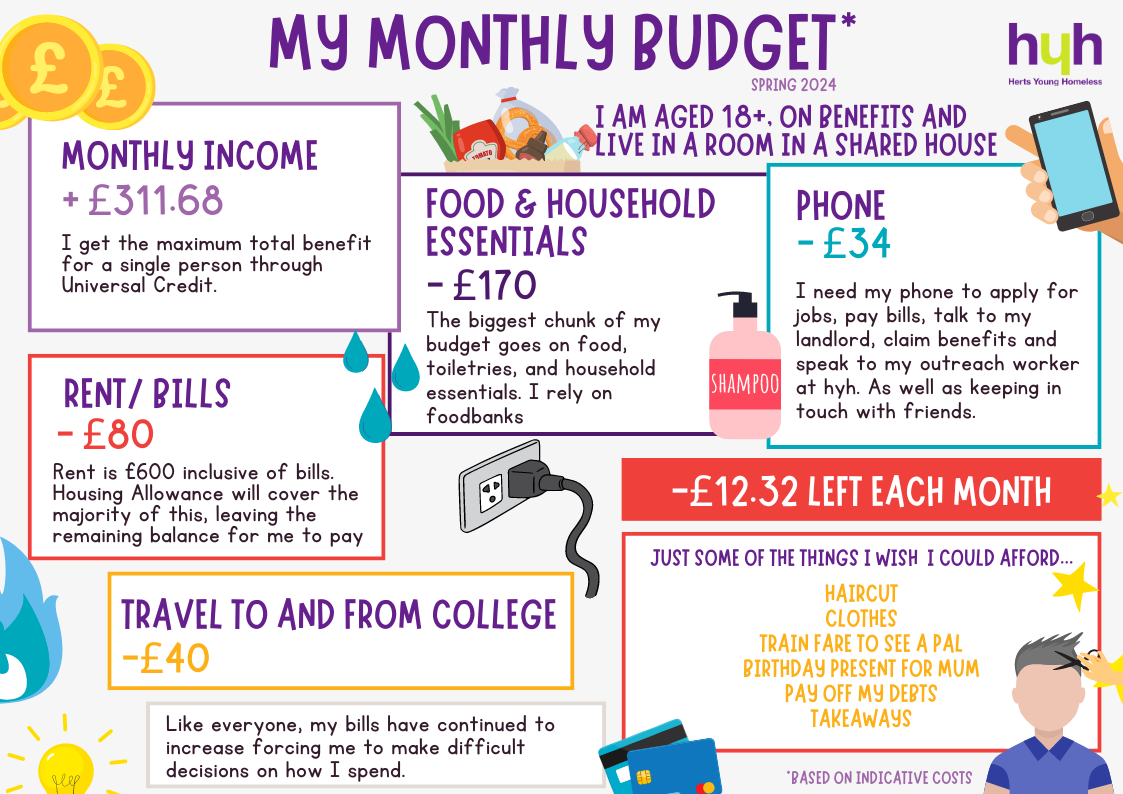
On benefits in a
shared house](/images/stories/price-benefits-room-in-a-shared-house.png) [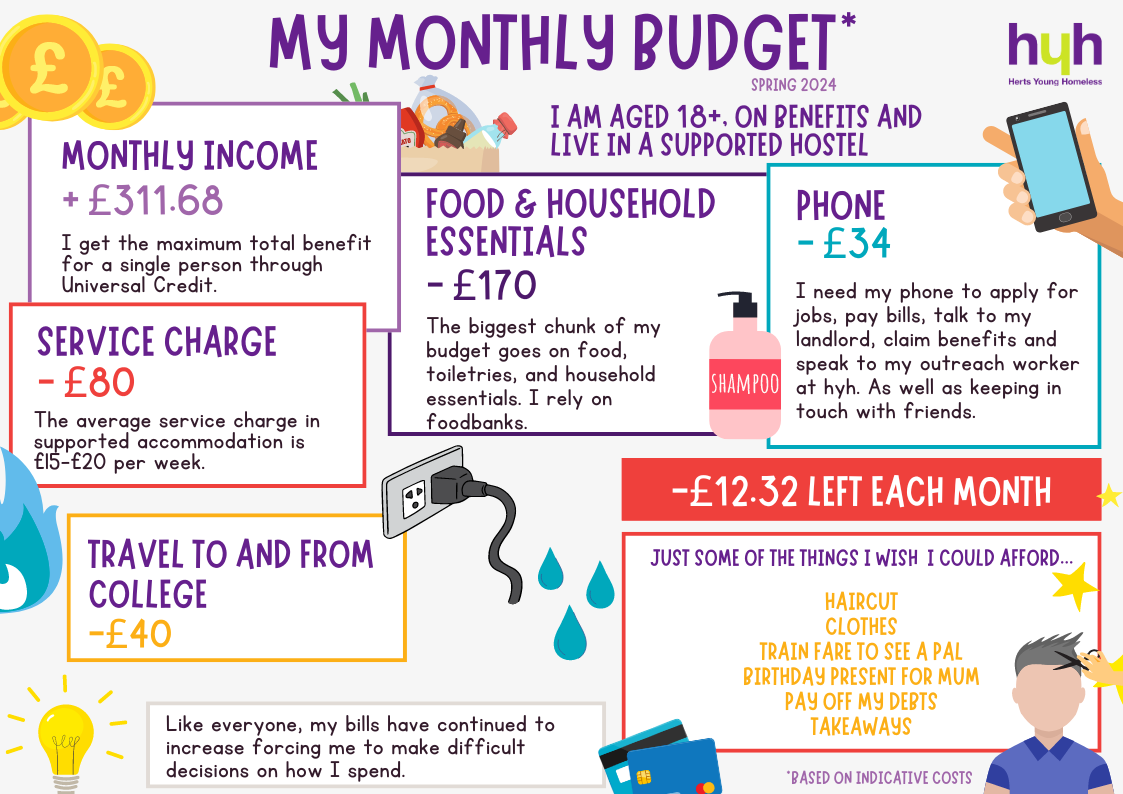
On benefits in a
supported hostel](/images/stories/price-benefits-supported-hostel.png) [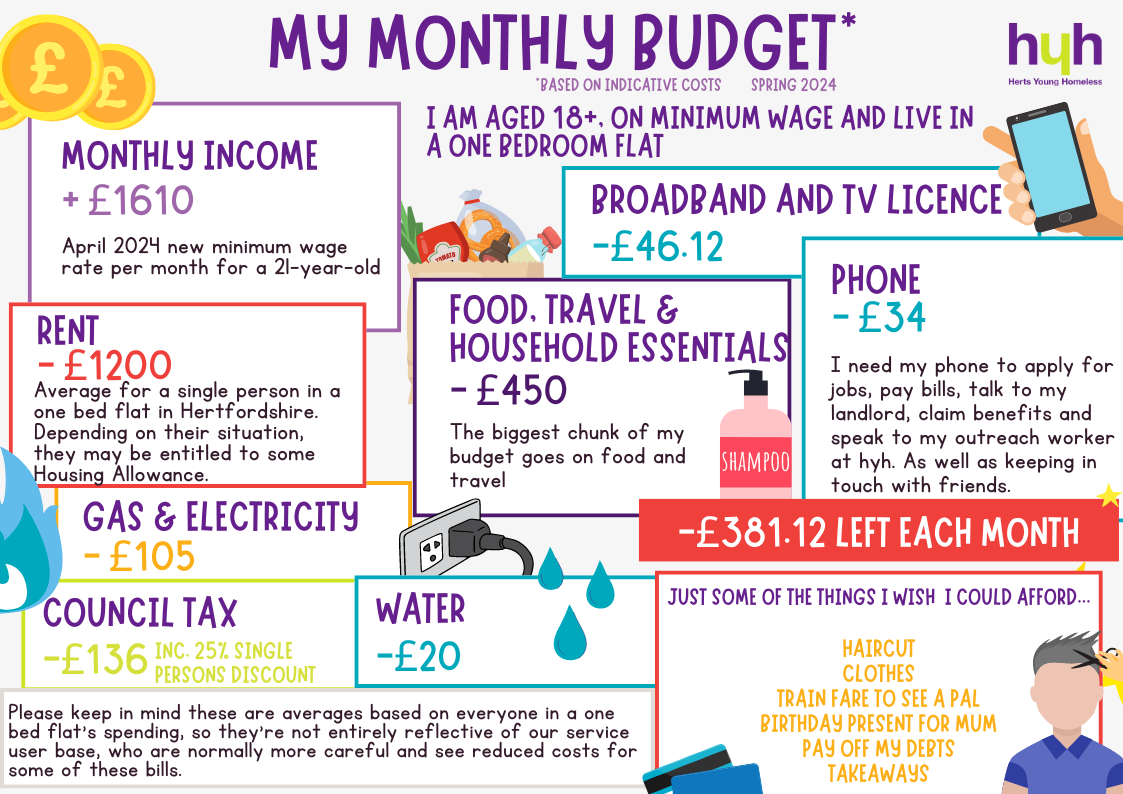
Minimum wage in a
one bedroom flat](/images/stories/price-minimum-wage-one-bedroom-flat.png) [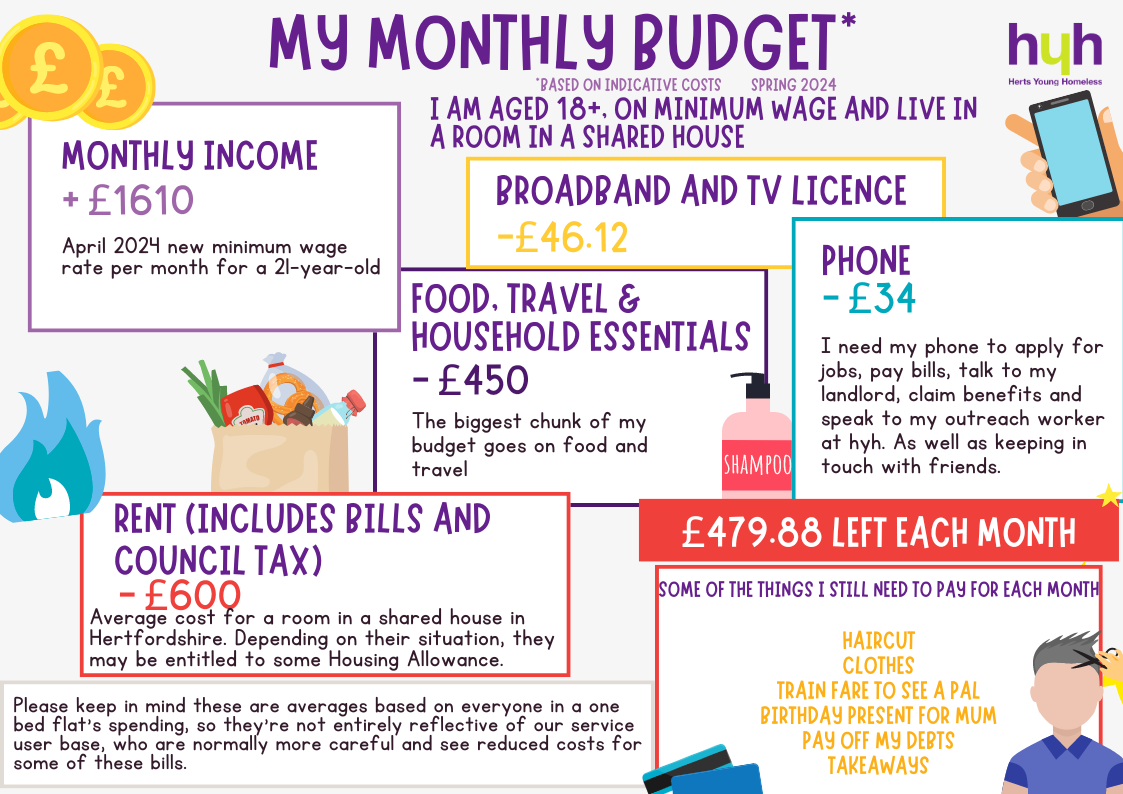
Minimum wage in a
shared house](/images/stories/price-minimum-wage-room-in-shared-house-2.png)
Let’s take a look at some of the different essentials, the rising prices of which are a cause for concern:
Food
Chicken wings are cheaper than vegetables
The cost of healthier food options is soaring. Healthier options are now often twice the price per calorie compared with less healthy alternatives. The implications this can have for longterm health are stark, and only further inequalities.
Shockingly, around 21% of 16-25 year olds even reported skipping meals to save money in the past year. We can all agree that everyone has the right to be treated with dignity, and this involves not having to worry about what or when you will next eat.
Transport
It’s cheaper to not go at all than to try and afford transport
Costly public transport has proven a barrier to many young people in accessing education, employment, and support services. The YMCA reported that young people have had to give up their apprenticeships due to high transport costs. This doesn’t even begin to touch upon the barrier to socializing opportunities that high transport costs can have, and the implications this can have for mental health. This is just one of the complex variety of factors in the cost of living crisis that can negatively impact mental health…
Mental Health
Financial pressures can result in poor mental health and poor mental health can result in financial pressures
43% of 16-25 year olds reported feeling anxious on a daily basis about the cost of living crisis and 10% were bullied for not being able to afford everyday costs. These impacts on mental health are not limited to the daily struggle to exist. Young people are forced to fear for their future and their lives as a whole, with over half worried that they will never be financially secure.
Understanding Finance
Finance is confusing if you aren’t taught how to deal with it
Basic finance is not taught enough, or at least consistently, in schools. Many young people lack a basic understanding of how to handle household finances such as holding a tenancy, paying bills, and budgeting everyday living expenses. Young people without knowledgeable parental figures to look up to often feel they are at a cliff edge when it comes to independent living. Lacking a support system and as a result, financial literacy, many young people are pushed over this cliff edge with nobody to catch them.
Minority groups
Some young people have it even worse
The cost of living crisis disproportionately affects those from ethnic minorities due to a variety of factors, including educational exclusion, or discrimination when it comes to job applications. This means that in 2023, the destitution rate for Black-led households was three times their population share. This can further inequalities later in life, having major implications for health and career prospects.
Young people’s voice is excluded
Young people need to be a part of the decisions being made for young people
Many young people feel they are excluded from the decisions and policies being made that directly impact them. There is a lack of opportunities for young people to have their opinions heard and to voice their concerns meaningfully and engage with those in power.
So, now what?
The cost of living crisis can be viewed as a ‘pandemic of poverty’- poverty will still be an issue even when inflation has stabilized. Solely economic responses to this crisis will not be enough to tackle it.
Evidence shows that preventative support and early intervention are really effective for young people. We need to take a long-term approach, tackling the crisis at its root instead of only reactive solutions. And these solutions need to be targeted to address the unique challenges faced by different social groups.
Many young people have been left carrying a very heavy load on their shoulders. The cost of living crisis, low wages and inadequate government support are all examples of pressures that can wear away and eventually, lead to a breaking point. These problems could be lessened with the right support. Youth homelessness costs £8.5 billion a year according to Centrepoint. By preventing youth homelessness at its root causes, we will significantly save further down the line.
Right now, people in Hertfordshire are struggling. hyh is committed to protecting the dignity and futures of these young people. hyh’s focus on the prevention of youth homelessness means we support young people to try and avoid crisis situations. Our education team deliver informative and engaging sessions in schools to teach topics such as independent living. Our Outreach team also offer support with budgeting skills, debt advice, and holding a tenancy- stopping young people from falling off that cliff edge when living independently.
With youth engagement being a core pillar of our approach to tackling youth homelessness, we aim to amplify youth voice wherever we can. This is a matter of public concern. Supporting the next generation will lead to happier and healthier lives for EVERYONE and strengthen society as a whole. We are interdependent as humans, and when some people are struggling, it hurts everyone. We are all pieces of the same puzzle.
By supporting hyh, you can help us take steps towards a fairer and safer world for young people. This way, we will achieve our vision of every young person having a safe home from which they can grow and thrive.
Resources used, and stats taken from:
https://publications.parliament.uk/pa/cm5804/cmselect/cmyouth/cost-living-crisis-young-people/report.html
https://www.princes-trust.org.uk/about-us/news-views/princestrustnatwestyouthindex2024
https://theconversation.com/its-not-a-cost-of-living-crisis-its-a-poverty-pandemic-218474